In Summary
Most running comebacks go sideways for one simple reason: people increase mileage (and intensity) faster than their body can adapt—classic “too much, too soon,” which Runner’s World highlights as a common beginner/returner mistake. This report provides an easy-to-follow framework (talk-test pacing, conservative weekly bumps, a built-in cutback week, and simple monitoring signals like resting HR and heart-rate drift) plus a 6‑week ramp template you can repeat. A Runmefit section at the end shows how to use your app/watch trends to catch fatigue early and stay consistent.
How to Increase Running Mileage Without Getting Hurt

You don’t get injured because you’re “bad at running.” Most of the time, you get injured because your training load changes faster than your body can adapt—especially when you’re returning after a winter slowdown. Runner’s World calls out the most common beginner/returner mistake as doing too much too soon, and the fix is simple: progress slowly and keep most runs easy.
This guide gives you a practical way to add miles without ending up sidelined. No complicated math, no technical jargon—just the habits that keep runners consistent.
Why mileage ramp-ups fail
The first few weeks back can feel amazing. Your motivation is high, the weather improves, and suddenly last year’s mileage seems realistic again. But your “engine” and your “chassis” don’t improve at the same speed. Runner’s World notes that beginners should aim for two to three runs per week over a multi-month period, focusing on time on your feet rather than forcing distance too early.
Here are the most common ramp-up problems (and what they look like in real life):
- Intensity creep (easy runs aren’t easy). Runner’s World recommends “conversational pace” for beginners—able to speak in full sentences—and suggests this effort is about 3–4 out of 10. If your so-called easy run turns into “kind of hard but manageable,” you’re quietly turning every day into a stress day.
- Big jumps in weekly volume. When in doubt, Runner’s World recommends the 10 percent rule: don’t increase weekly mileage or duration by more than 10% from the prior week. REI similarly suggests many runners limit increases to 10% (and even suggests 5% increases for people new to exercise and running).
- The long run becomes “the whole week.” Runner’s World coaches advise the long run shouldn’t exceed 25–30% of your weekly mileage because it becomes too stressful to recover from. If you only run twice a week, it’s easy for a weekend long run to accidentally become 50%+ of your total—and that’s where niggles start.
- Heat/hydration sneaks up on you. As training moves into warmer days, risk changes. The CDC warns that people who exercise on hot days are more likely to become dehydrated and get heat-related illness, and it explicitly advises: drink more water than usual (don’t wait for thirst), pace activity, and stop if you feel faint or weak.
The safe rules that actually work

If you want one headline: Build frequency and easy effort first; add volume second; add intensity last. REI describes a beginner path that starts with walking, then introduces run/walk intervals, and initially focuses on time before building speed, stamina, and mileage.
Here’s the framework:
Pick a realistic baseline. Your baseline is what you’ve done consistently for the last 2–3 weeks, not your best month last year. Runner’s World recommends focusing on time on your feet as a beginner to avoid crashing while chasing a distance goal.
Keep most runs easy (talk test).
REI’s talk-test shortcuts are simple and effective: easy pace = you can carry on a conversation; long-run pace = you can speak sentences but not long stories.
Increase gradually—and sometimes “hold.”
REI’s distance/endurance guidance says quickly increasing weekly mileage can risk injury and notes many experts recommend increasing weekly mileage 10–20% and then sticking with that amount for two weeks before bumping again. If you’re coming back from winter, it’s perfectly fine to repeat the same week until it feels “normal.”
Use a cutback week on purpose.
TrainingPeaks recommends building recovery weeks into a block; it describes a recovery week as a light week that happens every 2–3 weeks, and suggests dropping volume 50–60% from the prior week while keeping intensity light. (Recreational runners can also do smaller cutbacks if they feel okay—but the point is to schedule recovery before your body forces it.)
Add recovery runs the right way.
Nike says recovery pace is more about effort than speed—aim for 1–3 out of 10, and consider a route that’s flatter or 10–20% shorter than your usual loop. The goal is to finish feeling more energized, not depleted.
Strength train for durability.
Nike’s coaches call strength training “your insurance policy to not get hurt,” and emphasize that stronger, more durable legs support better form and fewer injuries. Two short sessions a week (20–30 minutes) is enough for most returners.
Warm up and cool down (don’t skip it).
REI recommends a 5–10 minute warmup (dynamic movement) to get blood circulating and wake up the body. For your cool down, REI advises gradually slowing down rather than stopping suddenly (easy trot to walk).
A simple six-week ramp you can repeat
This structure is a classic: build → build → build → cutback → build → build. It’s designed for recreational runners who want steady progress without the injury roller coaster.
Why this works: Runner’s World recommends slow progression (10% rule) and easy pacing (talk test, effort 3–4/10) while you build your base. TrainingPeaks describes recovery weeks as a deliberate way to absorb training stress by going lighter every few weeks.
Six-week numeric example
This example starts at 12 miles/week. Adjust the starting number based on your real baseline. Long-run targets use Runner’s World’s 25–30% guideline.
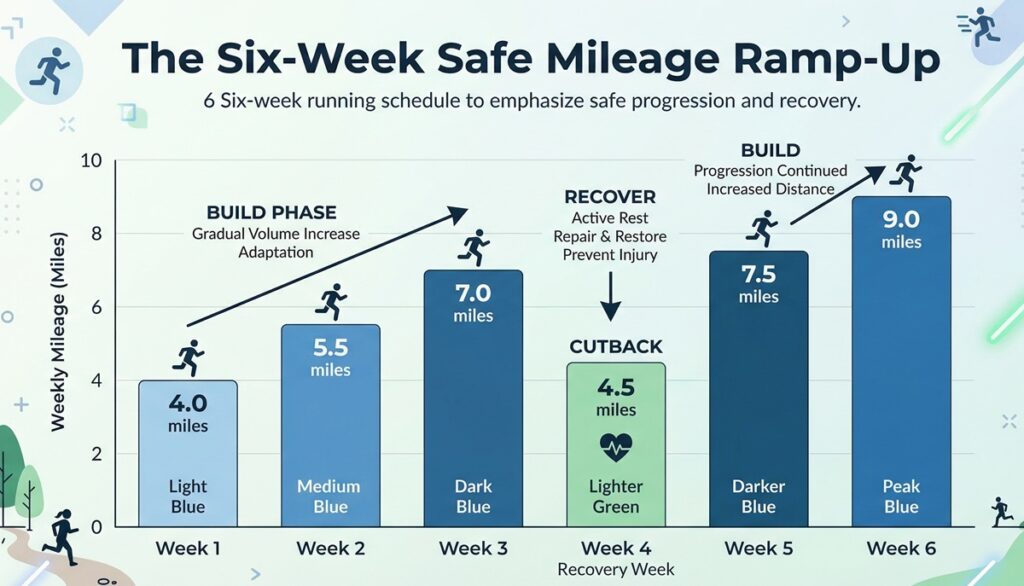
| Week | Weekly mileage example | Change | Long run target (25–30%) | What to prioritize |
|---|---|---|---|---|
| Week 1 | 12 mi | Baseline | 3–4 mi | Easy pace + consistency |
| Week 2 | 13 mi | +8% | 3–4 mi | Keep effort easy; no new intensity |
| Week 3 | 14 mi | +8% | 3–4 mi | Optional recovery run day (1–3/10 effort) |
| Week 4 | 9–12 mi | Cutback | ~3 mi | Recovery week: keep intensity light |
| Week 5 | 14 mi | Rebuild | 3–4 mi | Repeat volume to “lock in” adaptation |
| Week 6 | 15 mi | +7% | 4–5 mi | Long run stays in proportion; stay conversational |
If you only have 3 days a week to run, that’s still enough. REI emphasizes aiming for frequency and habit, not speed, especially early.
Monitoring: how to catch “too much too soon” early
Monitoring doesn’t need to be obsessive; it just needs to be consistent.
Use resting heart rate as a recovery clue.
Polar notes that morning resting heart rate can indicate under-recovery; if it’s elevated from your usual average by about seven or more beats per minute, that may mean you’re not fully recovered.
Compare heart rate on easy runs (like-for-like).
TrainingPeaks says the best comparisons are same route, similar time of day, and same pace—and it reminds readers that weather (temperature, wind, humidity) can influence heart rate. It also notes that a higher heart rate on a submaximal (easy) effort can indicate sickness, stress, fatigue, and/or dehydration.
Use heat safety rules when conditions change.
The CDC advises pacing activity, scheduling workouts when it’s cooler, drinking more water than usual (don’t wait for thirst), and stopping activity if you feel faint or weak.
A simple decision rule (use weekly trends):
- Green: easy runs feel easy; sleep is steady → continue building.
- Yellow: resting HR up; easy run HR higher than normal → repeat the week or swap in a recovery run (1–3/10).
- Red: heat illness symptoms (faint/weak) → stop and cool down; don’t “push through.”
How Runmefit helps you stay consistent
Everything above works without tech. But the advantage of a watch + app is trend visibility—especially when motivation is high and it’s easy to ignore early warnings.
What Runmefit can track (and why it matters).
Runmefit says the app tracks steps, calories, distance, heart rate, blood oxygen level, stress level/mood status, sleep data, and workout records, with charts and trends over time—exactly what you need for week-to-week ramp-ups.
Make runs easier to compare with Smarter Exercise Sync.
Runmefit’s app explains that starting Walking, Outdoor Run, or Cycling on your phone also starts it on your watch, and the app saves one unified workout record combining watch stats (including heart rate/activity) with the phone GPS route. This makes it simpler to compare “same route, same pace” over time—just like TrainingPeaks recommends for heart-rate comparisons.
WATCH 4 features that fit mileage building.
Runmefit WATCH 4 states it can auto-detect outdoor running, walking, and cycling (when auto-detection is enabled), and it includes Smart Reminders to move, hydrate, and reset. It also highlights detailed sleep tracking with AI-powered insights via the Runmefit App, and lists health metrics like heart rate, blood oxygen level, sleep tracking, HRV stress, and mood tracking in its specs.

FAQ
How quickly should I increase my weekly running mileage?
A simple rule is the 10 percent rule: don’t increase weekly mileage or duration by more than 10% from the previous week. Newer runners may progress closer to 5%.
What is a cutback week in running training?
A cutback (recovery) week is a deliberately lighter week to help your body absorb training. TrainingPeaks describes recovery weeks as light weeks that can happen every 2–3 weeks in a block.
How long should my long run be compared to weekly mileage?
Runner’s World coaches recommend your long run should not exceed about 25–30% of weekly mileage. Example: if your long run is 10 miles, aim for ~30 miles total that week.
What should a recovery run feel like?
Recovery pace is about effort, not speed: aim for a comfortable, controlled, conversational effort around 1–3 out of 10. Consider a flatter route or 10–20% shorter than your usual loop.